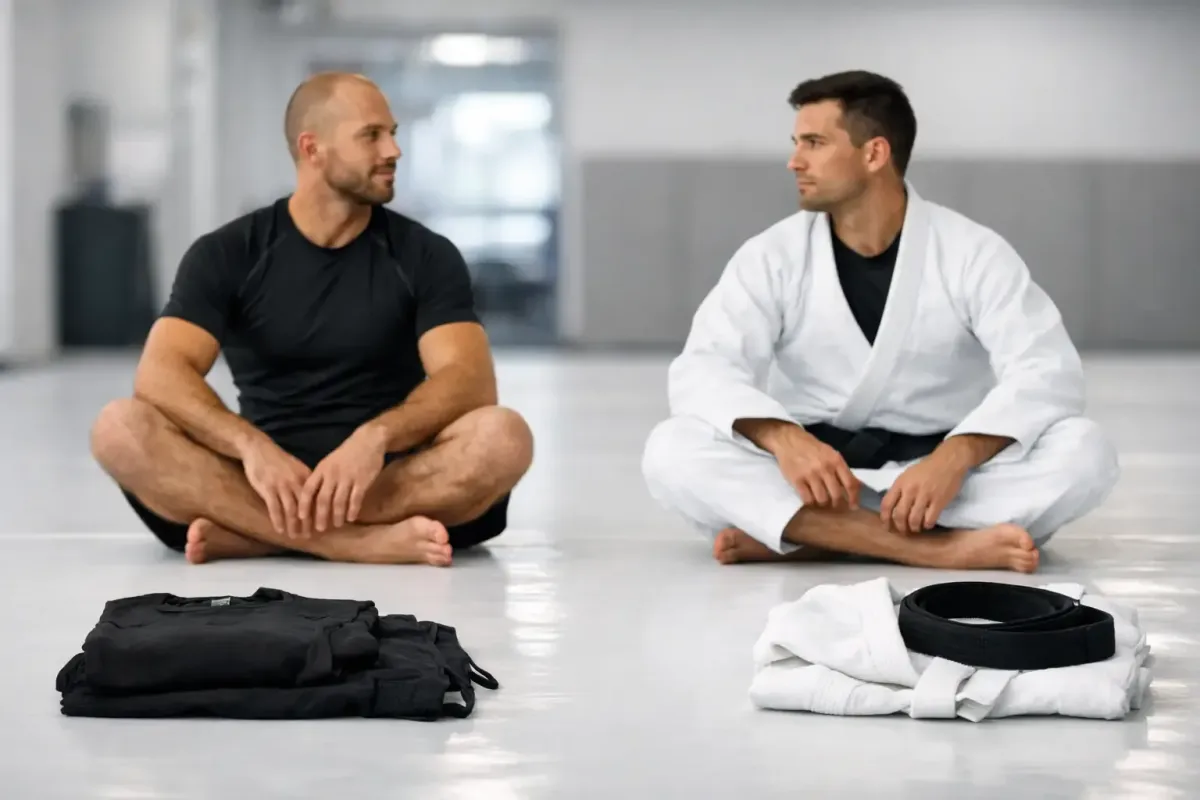
No-Gi vs Gi BJJ: What's the Difference and Why It Matters
Most people asking about no-gi vs gi BJJ are really asking a simpler question: what kind of training will I actually stick with?
That matters more than internet debates, uniform preferences, or tribal loyalty. If you train consistently, get coached well, and spend real time sparring, you improve. If you don't, the style doesn't save you.
That said, gi and no-gi do feel different. They reward different habits, expose different weaknesses, and attract different types of athletes. If you're brand new to jiu-jitsu in the Newark or Heath area, understanding those differences can save you time and frustration.
The Real Difference Between Gi and No-Gi BJJ
The biggest difference is friction and control.
In gi BJJ, both people wear a heavy jacket and pants, which creates grips everywhere: sleeves, collars, lapels, pant legs. Those grips slow things down and make it easier to pin, stall, break posture, and set traps over time.
In no-gi, you lose most of that cloth control. The pace picks up. People slip out of bad positions more often. Scrambles matter more. Body positioning, timing, head control, underhooks, and wrestling-style movement become a bigger part of the game.
That doesn't mean no-gi is just faster and gi is just slower. Good gi players can push a brutal pace, and smart no-gi players can suffocate you. But as a general rule: gi gives you more handles. No-gi makes you control the person, not the uniform.
For a beginner, that changes the learning experience right away. Gi can feel easier to understand at first because the grips give you ways to stop movement. No-gi can feel more athletic because people slide, scramble, and escape before you even know what happened.
How Each Style Changes Your Game
Gi BJJ builds patience. Because grips create more connection, exchanges become more layered and technical. You may spend longer in guard battles, grip fighting, and methodical passing sequences. Small grip adjustments can completely change a position.
No-gi puts more pressure on posture, angle, and transitions. If your weight placement is off, someone may be gone before you can fix it. If your pinning mechanics are sloppy, you find out fast. The room for error is smaller because sweat and movement make everything less forgiving.
Submissions change too. In the gi, collar chokes become a huge part of the game. In no-gi, you'll see more head-and-arm attacks, guillotines, rear naked chokes, leg locks, and quick upper-body finishes. Armbars still work. Triangles still work. But the pathways into those submissions often look different.
If your goal is becoming a complete grappler, both styles can teach useful lessons. Gi can sharpen precision and control. No-gi can sharpen pressure, mobility, and realistic body-to-body control.
Which One Is Better for Self-Defense?
This is where people get loud and oversimplify.
No-gi has an obvious practical advantage because real situations don't happen under tournament rules. The pace, wrestling influence, clinch work, and emphasis on controlling a moving body all transfer directly.
But writing off gi training completely would be lazy, especially in Ohio. Real people wear hoodies, coats, work shirts, and heavy jackets for a good chunk of the year. Learning how fabric affects posture, balance, and control is not useless.
The more honest answer is this: self-defense is not about the outfit. It's about whether you train against resistance, whether your gym teaches real positional control, and whether you regularly deal with pressure from people who don't want to cooperate. A school full of compliant drills and zero live rounds won't make you effective in either style.
For most adults focused on practical application, no-gi tends to feel more direct. Less tradition. Less costume. More emphasis on movement, pressure, takedowns, and holding onto someone who is actively trying to get away.
Fitness and Wear-and-Tear
Both styles will push your conditioning if you train with intent. Both will humble people who think they're already in shape. But the stress feels different.
No-gi usually involves more explosive entries, more scrambling, and more sustained movement. That can be great for people who want a hard pace. It can also be rough early on if you rely on speed instead of technique.
Gi training taxes the grip, forearms, and posture differently. Constant pulling and breaking cloth grips can wear people down fast. Some older students actually prefer no-gi because it reduces the repetitive strain of fighting fabric constantly. Others prefer gi because the slower pace lets them neutralize younger, faster opponents.
Age, prior injuries, and training style matter more than internet opinions on this one. A smart room with disciplined coaching makes both options safer.
What Beginners Usually Notice First
Walk into your first gi class and you'll probably notice that things feel more structured and sticky. People latch onto grips and positions can last longer. That extra second to think is useful when you're new.
Walk into your first no-gi class and you'll probably notice how physical and honest it feels. You can't cheat control with a sleeve grip if the sleeve isn't there. You have to learn where your hips go, where your head goes, and how to connect your body to someone else's.
For some beginners that makes no-gi easier to love right away, especially people who come from wrestling, football, or general strength training. For others, gi feels more manageable because the pace is easier to read early on.
Neither reaction is wrong. The wrong move is assuming one class tells you everything.
Why 10th Planet Newark Trains No-Gi Only
At 10th Planet Newark, we train exclusively no-gi. That's not an accident. It's the foundation Eddie Bravo built the entire 10th Planet system on.
The 10th Planet curriculum was designed specifically for no-gi competition and MMA. Techniques like the rubber guard, the lockdown, and the twister weren't adapted from gi techniques. They were engineered from scratch for a game without fabric grips. That's what makes 10th Planet different from a standard BJJ school that happens to offer no-gi classes. It's a complete no-gi system built from the ground up, refined at the highest levels of submission grappling competition.
Coach Jon Borrows is the only Eddie Bravo black belt in Ohio, promoted directly by Eddie on May 14, 2022. Every class at 10th Planet Newark runs on that lineage. Not a watered-down version of it. The real curriculum.
For people in Heath, Newark, Granville, Pataskala, Zanesville, and Mount Vernon who want to train BJJ, here's what that means practically:
No gi to buy. A rash guard and athletic shorts are all you need.
Techniques that transfer directly to MMA and real-world situations.
A pace that keeps training engaging and athletic.
A system battle-tested at the highest levels of no-gi competition.
So Which Should You Choose?
Choose the one you'll train three times a week.
That's the answer most people need, even if it sounds less dramatic than they hoped. A decent plan done consistently beats a perfect plan done twice a month.
If you like fast movement, practical control, wrestling-style exchanges, and a cleaner training setup, no-gi is probably your lane. If you like grip fighting, slower tactical exchanges, and the added layer of cloth-based control, gi has a lot to offer, you just won't find it here.
At 10th Planet Newark, we're a no-gi academy. Every class, every belt promotion, every competition we prep students for is no-gi. If that's the game you want to learn, your first class is free.
New to no-gi? See how our adult no-gi jiu jitsu classes work and pick a time on the class schedule.
Related reading: Best BJJ Gym in Heath & Newark, OH: What to Look For · What a Jiu-Jitsu Class Is Really Like | All Access Ep. 1
10th Planet Newark | 409 S 22nd St Suite 6, Heath OH 43056 | (740) 520-0112
Serving Newark, Heath, Granville, Pataskala, Zanesville, and Mount Vernon.
